Behind the deployment: How GCAS is scaling Gujarat's statewide admission support with Blue Machines AI
Building a unified, sovereign & multilingual admission support layer across phone, web chat, web voice, and WhatsApp, and pairing it with proactive outreach that reaches students before they get stuck.
A student in Navsari has scored 56% and wants to apply for B.Com, but the form is his father's first time on the portal. A student with 69.5% wants a Government Science College seat for Microbiology, in English medium, with a boys' hostel, and wants every one of those answers in a single Hindi call. A student already doing Chemical Engineering under GTU wants to know if they can pursue a BA in parallel, and whether it would help with UPSC.
None of these are "what is the last date" questions. They are real admission decisions, asked in the applicant's own words, in the applicant's own language, often late at night and usually with a parent listening in. For Gujarat Common Admission Services, this is the support challenge at the scale of an entire state.
That is the problem GCAS and Blue Machines AI set out to solve together: not to add a chatbot to the portal, but to build a trusted support layer that is always available, speaks the student's language, stays grounded in official GCAS information, and reaches students proactively at the moments that matter in the admission cycle.
Admission support at the scale of a state
GCAS unifies higher education admissions across Gujarat's 15 state universities and 18+ private universities into one digital process: 2,500+ colleges, 300+ programs, and more than 25,000 unique program types, operated by the Knowledge Consortium of Gujarat.
A centralized system makes admissions more transparent, but it does not remove the need for guidance. It concentrates on it. Students who once relied on individual colleges, local counselors, or word of mouth now have one process to understand and complete correctly, on a deadline. A missed date, a wrong form, an unclear category, or a misread cutoff can directly change what a student can do next. For first-generation applicants and families in smaller towns, that uncertainty is heaviest.
So the support has to match the system: available beyond office hours, multilingual, able to absorb large volumes without queues, and consistent enough that no student is relying on unofficial advice.
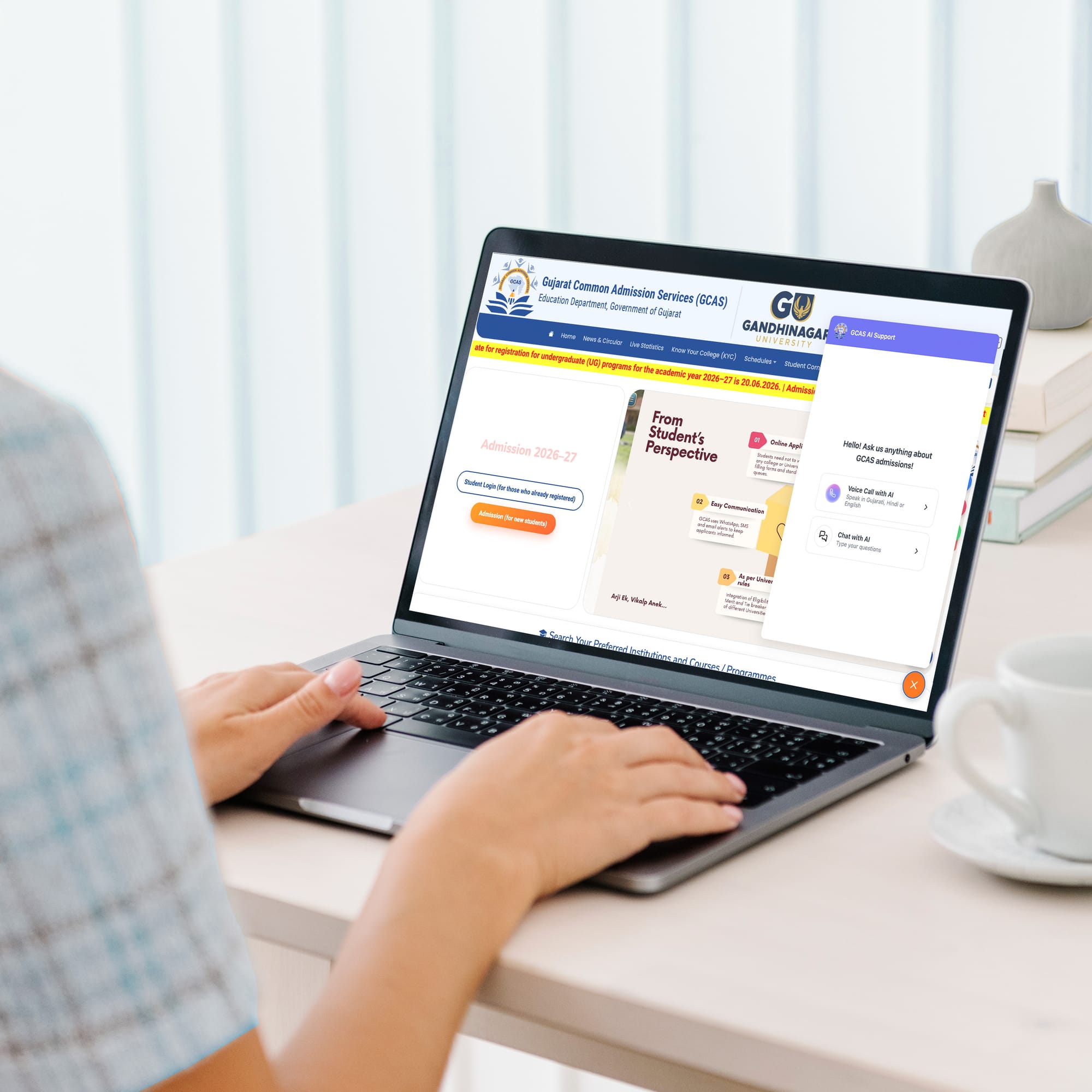
A support layer that meets students where they are
Students do not move through one channel. A student may get a WhatsApp update, open the portal, ask a question in web chat, switch to a phone call when it gets detailed, and come back later to check cutoffs. Blue Machines built the Admission Support Centre as a multimodal layer, not single-channel automation:
- Phone for students and parents who would rather talk it through.
- Web chat for step-by-step written guidance while on the portal.
- Web voice for browser-based voice support.
- WhatsApp to keep students informed and nudged across the cycle.
Context carries across these touchpoints, so a student never feels like they are starting over.
Two jobs, not one: answer, and reach out
Most support systems wait to be asked. GCAS needs both directions.
Inbound, the assistant answers the high-context questions above: eligibility, cutoffs, fees, documents, college and program discovery, and portal troubleshooting, grounded in official GCAS data.
Outbound, a proactive engagement agent works the admission timeline itself. The outbound journey is built as a sequence of 37 (number) touchpoints across the overlapping registration rounds, from a registration nudge for students who signed up but have not completed their form, to reminders through choice-filling, to seat-acceptance prompts once allotments are out. When admissions run on tight, rolling deadlines, a well-timed call or message is often the difference between a student moving forward and a student dropping off.
This is the part that makes the deployment more than a helpdesk: the same grounded, multilingual agent both responds when a student reaches out and reaches out when a student is about to fall behind.
Grounded in official GCAS information, by design
For a public admission system, accuracy is not a feature. It is the foundation of trust. The assistant is built around verified GCAS information and admission-specific boundaries. It shares cutoffs and fees as facts, never as predictions: it will not tell a student whether they will "get in." When a question falls outside its scope, it does not improvise. Engineering and medical admissions are redirected to the relevant official platforms, and anything needing backend intervention or official modification is routed to the right support channel.
That discipline is deliberate. A generic chatbot tries to answer everything. This system is built to help students navigate the GCAS journey correctly, and to know exactly where its answers end.
The hard part was the craft
Getting a demo to work is easy. Getting a public, trilingual, high-stakes admission agent to behave correctly on a live call, every time, is where the real work happened.
Language, done properly. Students and parents speak Gujarati, Hindi, English, and freely mix them, including Gujarati and Hindi typed in English script. The agent detects the language a student is actually speaking and locks to it, and can switch mid-call when the student does. Everything the agent speaks is written in native script so the voice engine pronounces it correctly, and numbers, dates, and academic-year ranges are rendered as spoken words rather than digits, so "69.5 percent" and "twenty twenty-six" come out right in Gujarati rather than as an English-accented misread.
Handoffs that never over-promise. When a student needs a human, the agent states the correct helpline in the same turn. It never claims it is "connecting you now" or transferring the call, because it cannot, and a false promise erodes trust faster than no answer. If a student asks not to be contacted, that is respected immediately. If a student is busy, the agent captures a callback instead of pushing.
Advancing on facts, not assumptions. A student saying "I have paid" or "I submitted" is not the same as the portal confirming it. The outbound journey only advances a student to the next stage when the system state actually reflects it, which keeps the agent from congratulating a student on a step they have not finished.
These sound like small rules. Together they are the difference between an assistant students trust and one they learn to ignore.
What the numbers show
As of 30th June 2026, the GCAS AI Assistant has handled ~20 lakh interactions for 4 lakh + unique students, across voice and chat conversations, plus ~20 lakh WhatsApp messages sent across support and outreach.
The mix tells the story better than the totals:
- No single channel wins. Phone is 50.2% of interactions, web chat 46.9%, web voice 2.9%. Students pick the channel that fits the question.
- These are conversations, not lookups. An average voice call of ~200 seconds and chat session of 242 seconds, and close to 40% of interactions running past three minutes. Students stay to understand, compare, and decide.
- Gujarati leads. 57% of interactions are in Gujarati, 16% English, 14% Hindi, the rest mixed, which is exactly why building around the student's primary language mattered.
- Registration is where students need the most help. Registration guidance is 26% of queries, followed by schedule and deadlines (13%), specific colleges (12%), login and OTP access (9%), and PG programs (8%). The top five cover 68% of everything students ask.
Reaching the students who had the least access
Ahmedabad is the largest source of interactions at 42.5%, followed by Surat (19.3%), Vadodara (10%), and Rajkot (7.8%). But the point of the deployment is what happens beyond those hubs. Students and parents from Sabarkantha, Mahisagar, Banaskantha, Chhota Udepur, Dang, Tapi, Kutch, Devbhoomi Dwarka, and dozens of other districts are using the same support, in the same languages, at the same hours.
A student in a small town no longer depends on local word of mouth to understand their options. A parent in a remote district can ask in a familiar language without waiting for an office to open. A first-generation applicant can get structured help with forms, documents, cutoffs, and choices without needing to know someone inside the system. For a statewide process, that is where "digital" starts to mean "accessible."
Built the Forward-Deployment way: live fast, then improve relentlessly
The inbound helpline went live on 7 May 2026, within 14 days of the work order, and it has not stood still since. Blue Machines works as an embedded Forward-Deployment partner: the agent has been iterated through dozens of versions across the cycle, driven by a tight loop of live-call review, root-cause analysis, and same-week fixes.
Every change runs through the same rigor: automated checks that verify every conversation path stays reachable, hygiene gates on agent-facing content, post-call evaluations that tag outcomes like callback needs and out-of-scope requests, and a test suite built from real interaction patterns. That is how a public-facing agent stays accurate while it keeps changing.
Sovereign AI, solved
This deployment is also a live example of what Sovereign AI can look like for India, not as a policy phrase, but as a working public system.
The assistant runs on Gujarat’s admission context, answers in the languages Gujarat’s students and parents actually use, and stays within the boundaries defined by the state’s own institutions. It does not behave like a generic chatbot trained to answer everything. It is grounded in official GCAS information, limited to the admission journey it is meant to support, and designed to know where its answers end.
That matters because sovereignty in AI is not only about where the underlying model comes from. It is about who controls the language, data, workflow, and decision boundaries of the system. For GCAS, the mandate stays with the Knowledge Consortium of Gujarat. The official data stays the source of truth. The assistant exists to strengthen the state’s support infrastructure, not replace it.
Data residency was treated as part of that trust architecture from day one, not as a compliance checkbox added later. Student and applicant data collected through GCAS is governed within a defined, auditable infrastructure boundary, under the same ISO 27001 and ISO 27701 certified security and privacy practices that apply across Blue Machines’ platform. For a statewide admissions system handling information from more than 4 lakh students and their families, keeping data governance clear, controlled, and auditable is inseparable from the trust the assistant is built to earn.
That is what makes this more than admission automation. GCAS brings the public mandate, official information, and statewide reach. Blue Machines AI brings the multilingual conversational infrastructure, guardrails, workflow design, and deployment discipline. Together, the system becomes a layer of trusted digital public infrastructure: one that speaks the student’s language, follows the state’s rules, and helps every applicant move through the admission journey with more clarity and confidence.
About Blue Machines AI
Blue Machines AI is Apna Group's enterprise-grade Voice AI platform, built to help organizations deploy compliant, low-latency, multilingual voice AI agents at scale. With production-ready infrastructure and Forward-Deployment Engineer support, Blue Machines helps enterprises integrate voice agents into real workflows, resolve issues in real time, and operate confidently at scale. The platform has a 100 percent go-live success rate and enables organizations to launch Voice AI in under a week.